
UX RESEARCH CASE STUDY
From Friction to Roadmap
| My Role: | Lead UX Researcher |
| Company: | The Home Depot |
| Project: | Call for Price (CFP) B2B Internal Pricing Tool |
| Timeline: | 8 weeks, planning to final readout |
| Methods: | User interviews, vendor research, analytics review, journey mapping |
| Participants: | 24 internal users, 6 external vendors |
| Deliverables: | Research readout, journey map, UX opportunity framework tied to OKRs |
The Challenge
Home Depot's Call for Price (CFP) feature is the tool the Complex Quoting team, Pro Sales Associates, and Pro Account Managers use to build quotes for large professional customers. CFP lets associates source and price products that aren't in the standard catalog, which is what makes it the key to closing large, complex jobs.
That importance was not matched by the experience. Pro Sales Associates worked around broken features, Complex Quoters built improvised steps to finish their jobs, and vendors had purchase orders rejected or go missing. The cost of that friction had not been measured until now.
$1.6M
Lost sales from PO rejections
30 hours
To complete one large project quote for a $550K, 200+ line-item job
Methods
This called for a mixed-methods approach, pairing interviews and direct observation with analytics so that what users described in their own words could be cross-checked against the data. The study covered 24 internal users and 6 external vendors across the segments that touch CFP.
| Method Type | Description |
|---|---|
| Qualitative |
Internal Users
Interviews with Pro Sales Associates, Pro Account Managers, and the Complex Quoting team.
External Users
Vendor and supplier interviews to cover the fulfillment side.
|
| Quantitative |
|
Understanding the Users
Usage was heavily skewed. The Complex Quoting team owned 64% of CFP orders and most of the highest-stakes work, so the persona below anchored the study while the segments table held the broader picture.
Complex Quoter
Primary Persona
Context
Builds quotes for the largest Pro jobs, often multi-building projects with hundreds of line items and a mix of catalog and non-catalog products.
Goals
Source non-catalog items quickly, hold pricing across long bid cycles, manage truckload logistics without hand-keying the same data twice.
Pain points
No validation when entering unit of measure, category, or model number. Vendor responses scattered across email and PO systems. Multiple rounds of manual re-entry to keep records aligned.
What success looks like
A complete, accurate quote delivered before the customer moves on to a different supplier.
User Segments Studied
| User Segment | Usage Rate | Primary Need |
|---|---|---|
| Complex Quoting team | 64% of orders | Pricing flexibility, bulk ordering, truckload management |
| Pro Account Managers | 16% of orders | Access to products outside the standard catalog |
| Pro Sales Associates | 10% of orders | Better pricing and quantities for large Pro customers |
| Vendors and Suppliers | Fulfillment-side | Flexible product assortment without full catalog maintenance |
Key Findings
| 1. CFP is essential and irreplaceable For Lumber alone, 91% of lumber orders run through CFP. Removing or deprioritizing the feature would halt sales across the business units that depend on it. | 2. CFP lacks guardrails The feature has no meaningful validation or error prevention. Users routinely entered the wrong unit of measure, category, or model number, and the system gave no feedback when they did. |
| 3. Associates are succeeding through workarounds Users had built a rich set of workarounds, treating CFP as a bypass when catalog search failed. The workarounds were standardized enough across teams to function as informal processes. | 4. The 30-hour problem Journey mapping the Complex Quoting workflow surfaced the headline number: a single $550K project (two buildings, 200+ line items) took roughly 30 hours end-to-end across manual data entry, vendor follow-ups, and document review. |
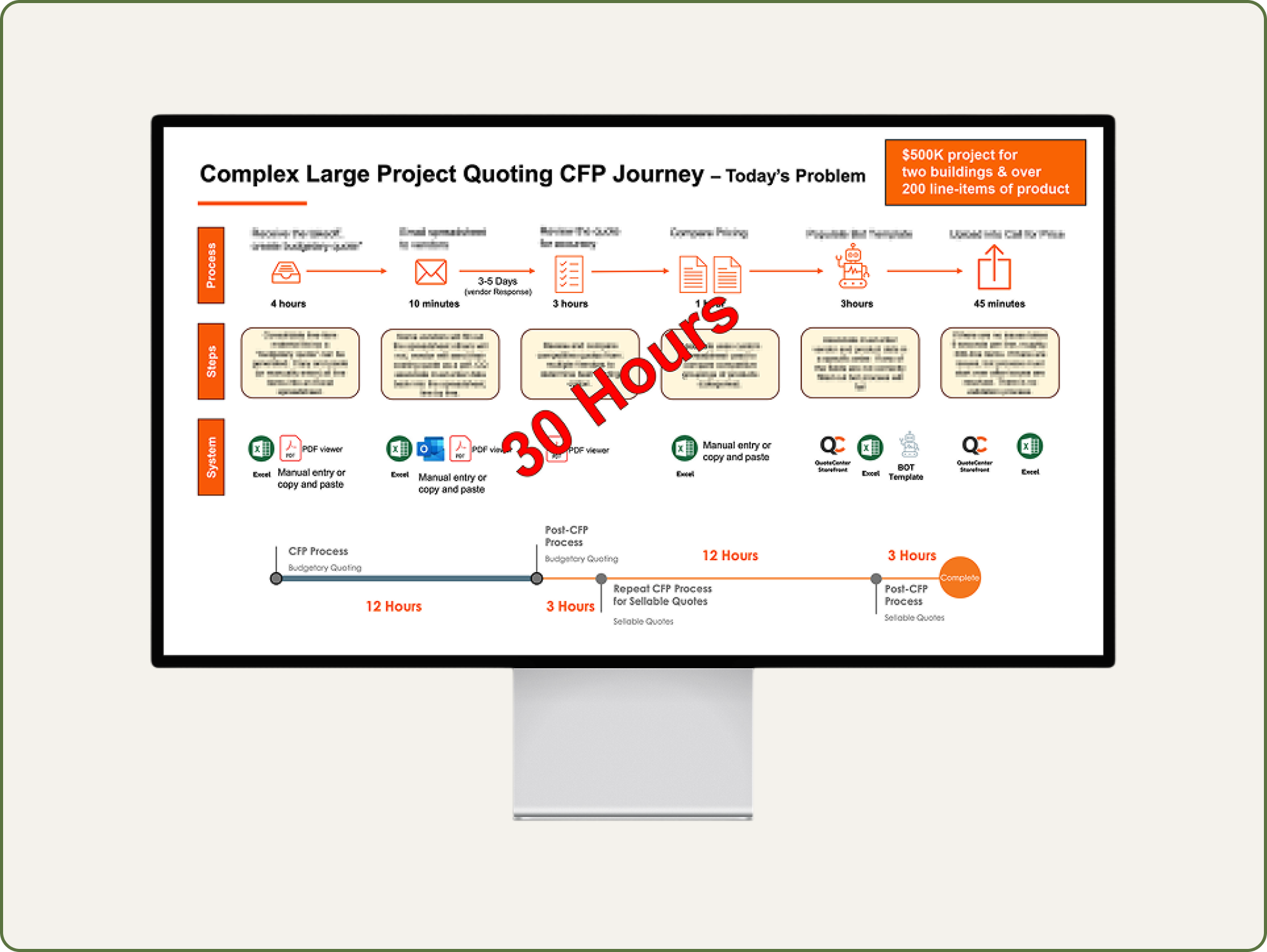
Journey map used in the leadership readout. The 30-hour figure became the version of the problem that traveled across product, design, and business stakeholders.
From Insights to Action
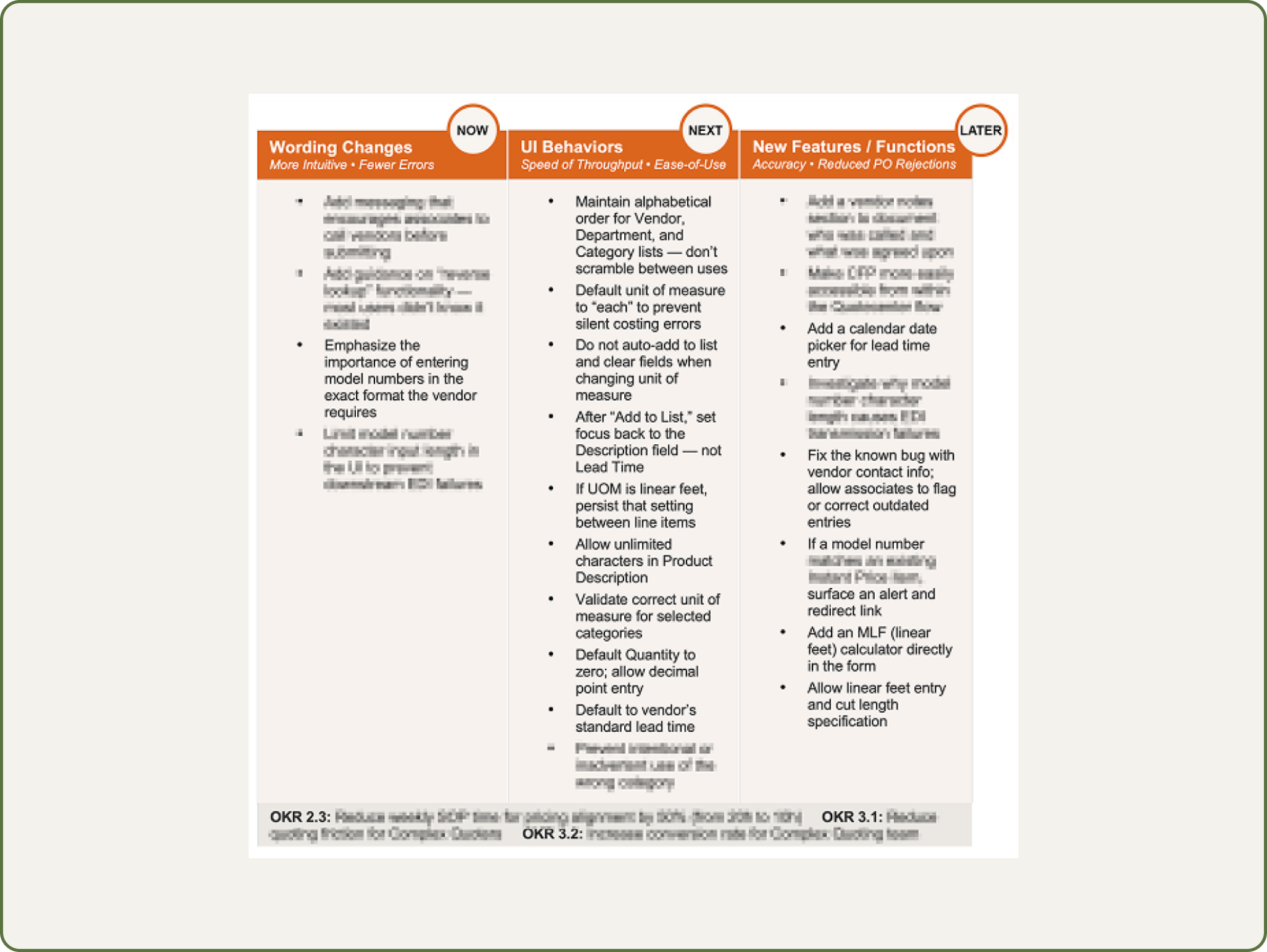
The recommendations were organized into the Now/Next/Later framework. This was a joint effort by Product and UX calculated by effort-to-impact ratio against current team capacity. Each recommendation was tied to a department OKR, which let prioritization happen inside the planning cycle the team was already running.
Impact and Reflection
The readout was delivered to product, design, and business stakeholders in June 2024. Next steps were a prioritization workshop and a Lean UX Canvas for the near-term enhancements identified in the "now" bucket.
The part of this work I'd point to is how the research shaped the language leadership ended up using. The 30-hour journey map turned an abstract usability complaint into a number that fit on a single slide. The $1.6M in lost PO revenue gave the vendor side of the story its cost. Both became how the team described the problem afterward.
What the project taught me how crucial research is to any business process. Hours of interview synthesis had not moved the conversation on its own. But putting everything together in one context definitely did.